


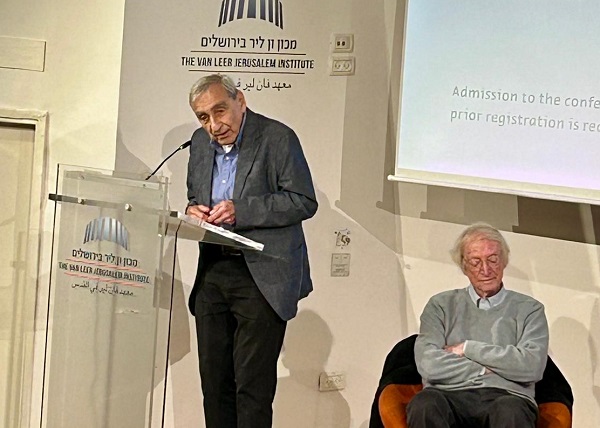
A Note on the Conference in Honor of His 90th Birthday
By Anne Rethmann
At the conference in honor of Michael Walzer’s ninetieth birthday at the Van Leer Institute in Jerusalem on Sunday, November 30, the renowned political philosopher and author of Just and Unjust Wars (1977), Spheres of Justice (1983), and most recently The Struggle for a Decent Politics (2023), returned to the moral vocabulary that has shaped his work for half a century—now refracted through the trauma of October 7, 2023 and the war that unfolded in Gaza in its aftermath. Although the conference featured commentaries and a wider discussion, this report concentrates on Walzer’s keynote remarks. He began by insisting that the category of “non-combatants” is a legal and moral distinction, not a judgment about purity of heart or political virtue. Even where a pervasive culture of Hamas exists in parts of Palestinian society, the protection of non-combatants remains binding, precisely when emotions run highest.
Walzer identified himself, once again, not only as a just war theorist but also as a diasporist Zionist. He criticized scholars and journalists who, already on the afternoon of October 7, focused almost exclusively on Israeli military actions while failing to emphasize Hamas’s responsibility for initiating the war. Palestinians, he argued, must confront Hamas and articulate why Hamas launched a massacre against civilians. Yet his focus that afternoon—speaking to an Israeli audience—was the war Israel has been fighting since October 7. In his view, the war began as a just one, directed against an enemy openly committed to killing Jews (he used the word Jews) and provoking a devastating response in Gaza. But the Israeli government, he argued, gradually allowed its priorities to become distorted, losing sight of proportionality, political horizon, and the heightened obligations that fall on high-tech armies in asymmetric conflicts. Hamas aimed not only to kill Jews, he stressed, but also to induce Israel to kill Palestinians—a trap that demands strategic imagination to escape. If there is no way to win, he warned, then the effort to win risks becoming a criminal act.
Walzer also reminded the audience that it was President Joe Biden who displayed moral clarity in the earliest phase. Biden stood up for Israel from the outset and, Walzer suggested, proved to be a genuine friend. The Biden plan for the “end of the war and the day after”, he noted, had already been formulated a year earlier; Trump’s later proposal merely imitated Biden’s. Yet the plan never translated into political reality. One might add that Hamas and Hezbollah still possessed sufficient military and strategic capacity to block any meaningful diplomatic opening, and that within the Israeli government the willingness to consider an end to the conflict was minimal. These two obstacles—non-state actors capable of renewed escalation and a governing coalition committed to continued confrontation—undermined the viability of Biden’s early initiative.
Walzer expressed admiration for the civilian protesters who took to the streets in Tel Aviv, Jerusalem, and across the country to demand the release of the hostages; for those who intervene against settler violence in the West Bank; and, yes, also for IDF soldiers who bear the burden of a brutal conflict—most of whom, he emphasized, do not conform to the fantasies projected onto them. Yet he judged both the erosion of discipline within the IDF and, above all, the government’s failure to articulate an endgame—a way out rather than merely a way through—as a grave moral and political failure. The task, he insisted, is to preserve the possibility of coexistence even in the midst of war. He concluded with a plea rather than an argument: moral reckoning will remain essential, and—speaking to an Israeli audience—Israel must “get it right.”
Listening to a man who has visited Israel more than forty-five times and who spent a semester in 1983 teaching a seminar on war and morality at the Hebrew University to students who knew war firsthand—far more intimately than a New York professor ever could—was a rare moment of intellectual clarity. It was the voice of a thinker who sees suffering and violence on both sides without claiming to hold the final answers, yet who can still offer guidance. Such voices are strikingly scarce in today’s academic debates on Israel, Gaza, and war.
His reflections at this symposium illuminate both continuity and change in his thinking. They also offer a living frame for rereading his 2002 essay “The Four Wars of Israel/Palestine”. The distinctions he drew there—between four simultaneous and overlapping wars—become newly resonant after October 7. The Hamas attacks made visible what Walzer had described as the first war: a campaign not of negotiation but of destruction, communicated through brutal terror. At the same time, the possibility of the second war—a legitimate struggle for Palestinian statehood—was gravely weakened, not because its justice vanished, but because no authoritative Palestinian actor emerged capable of disentangling it from the first. Israel’s response, meanwhile, reflects the third war: the defensive struggle for security within its recognized borders—a just war. Yet the fourth war, the project of Greater Israel advanced by far-right factions and the settler movement, has simultaneously gained influence, reinforcing maximalist dynamics on both sides. Walzer’s insight—that the unjust wars structurally undermine the just ones—now reads as a description of political reality.
The commentators following his talk, Raef Zreik and Yael Sternhell, emphasized the uncertainty of the present. No one in the room could say with confidence whether this is the end of the war, a pause, or a low-intensity continuation. The danger of regression remains acute. Walzer’s call for moral reckoning resonates here as well. It will be decisive in shaping the aftermath and must guide judgment—both in the region and abroad. His appeal stands not only for Israelis: “get it right.”
And from my side as well: Mazel tov, and happy birthday, Professor Walzer.
Anne Rethmann is a Postdoctoral Fellow at the Martin Buber Society of Fellows in the Humanities and Social Sciences at the Hebrew University of Jerusalem.