| A PERSONAL MEMOIR OF
"KRISTALLNACHT" "A wave of destruction,
looting, and incendiarism unparalleled in Germany since the Thirty Years War
(1618-1648,ed.) and in Europe generally since the Bolshevist Revolution
swept over Great Germany today as National Socialist cohorts took vengeance
on Jewish shops, offices and synagogues for the murder by a young Polish Jew
of Ernst vom Rath, third secretary of the German Embassy in Paris..."
Thus started the article on page 1 of the New York Times of
November 11, 1938, reporting the events which were to become known as the
November pogrom or „Kristallnacht". I recently reread this article with
very deep emotions almost 60 years after witnessing a small part of this
wave of hate and violence as a teenager in Berlin.
Thursday, November 10, 1938, started like any other day, I left
our apartment on Kaiserdamm in the Westend section of Berlin at around
7:20 for the nearest rapid transit (the so-called S-Bahn) station, a
half-mile walk past apartment buildings and one-family villas. There were
no signs of any unusual activities. From there I took the train for a
15-minute ride to the Tiergarten Station in central Berlin near the high
school of the orthodox congregation Adass Yisroel where I arrived a few
minutes before the beginning of the school day at 8 o’clock.
When I entered my classroom, some of my classmates were telling
horror stories of what they had seen on their way to school like smashed
store windows of Jewish-owned shops, looting mobs, and even burning
synagogues. A fair number of students was absent. The 8 o’clock bell rang
signaling the beginning of classes, but no teachers were in sight either
in our class or in any of the other classes along our corridor. That had
never happened before. I don’t remember anymore how long it took for the
teachers to emerge from the teacher’s conference room finally opened and
the teachers streamed out to their various class rooms, they all looked
extremely grim.
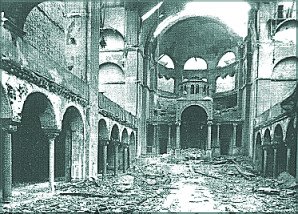 |
Synagoge
Fasanenstraße
Innenraum nach dem Pogrom
im November 1938 |
When our teacher Dr. Wollheim entered the room and closed the
door, all talking stopped instantly, and there was complete silence in the
class. That too was unique, for in general we were a fairly undisciplined
bunch, and it usually took several admonitions until some quiet was
established.
In a tense voice Dr. Wollheim announced that school was being
dismissed because our safety could not be guaranteed. This was followed by
a number of instructions which he urged us to follow in every detail.
Number one, we should go home directly and as fast as possible without
lingering anywhere or visiting friends so that our parents would know that
we are safe. Number two, we should not walk in large groups because that
would attract attention and possible violence by hostile crowds. He
concluded by saying that there would be no school for the foreseeable
future and that we would be notified when school would reopen again.
I quickly walked back to the Tiergarten Station and decided to
look out the window when the elevated train would pass the Synagogue
Fasanenstrasse where I had become Bar Mitzvah. It was a beautiful
structure built in Moorish style with three large cupolas. I literally
felt my heart fall into my stomach when I saw a thick column of smoke
rising out of the center cupola. There was no wind, and the column seemed
to stand motionless reaching into the heavens. At that moment all
rationality left me. I got off the train at the next stop and raced back
the few blocks as if pulled by an irresistible force. I did not think of
Dr. Wollheim’s instruction nor of any possible danger to myself. Police
barricades kept a crowd of onlookers on the opposite sidewalk. Firefighter
were hosing down adjacent buildings. The air was filled with the acrid
smell of smoke. I was wedged in the middle of a hostile crows which was in
an ugly mood shouting antisemitic slogans. I was completely hypnotized by
the burning synagogue and was totally oblivious to any possible danger. I
thought of the many times I had attended services there and listened to
the sermons all of which had fortified my soul during the difficult years
of persecution. Even almost six years of Nazi rule had not prepared me for
such an experience.
Suddenly someone shouted that a Jewish family was living on the
ground floor of the apartment building across the street from the
synagogue. Watching the fire, the crowd was backed against the building.
Someone else shouted: „Let’s get them!" Everyone turned around. Those
closest surged through the building entrance. I could hear heavy blows
against the apartment door. In my imagination I pictured a frightened
family hiding in a room as far as possible from the entrance door - hoping
and praying that the door would withstand, and I prayed with them. I
vividly remember the crashing violent noise of splintering wood followed
by deadly silence, then suddenly wild cries of triumph. An elderly
bald-headed man was brutally pushed through the crowd while fists rained
down on him from all sides accompanied by antisemitic epithets. His face
was bloodied. One single man in the crowd shouted: „How cowardly! So many
against one!"
He was immediately attacked by others. After the elderly Jew had
been pushed to the curb, a police car appeared mysteriously; he was put in
and driven off. I left this scene of horror completely drained,
incredulous, in a trance and went home.
Decades later i came across an article in the Berliner Tageblatt
of August 26, 1912, describing the dedication ceremony of the synagogue on
Fasanen Strasse. In the light of the destruction of that synagogue which I
witnessed 26 years, 2 months, and 15 days later on November 10, 1938, this
dedication ceremony represents a bitter irony on several planes. I think
it is historically significant enough to quote some excerpts from this
article here: „The festive dedication of the new synagogue on
Fasanenstrasse took place at midday today in the presence of the highest
representatives of government, the military, and the city ... At 12
o’clock sharp the personal representative of the Kaiser, his military
adjutant Colonel General Excellency von Kessel arrived. He was seated on a
seat of honor on the bimah. Next to him sat the Undersecretary in the
Ministry of the Interior Holtz.
In the first row one could see the representative of the
Ministry of Religious Affairs, Director von Chappius ... and for the High
Command of the Armed Forces Colonel von Brauchitsch. The city of Berlin
was represented by Lord Mayor Wermuth, ... The Chief of Police von Jagow
in the uniform of a cavalry colonel, and his deputy, Councilor Friedheim.
In addition many representatives of the Protestant and Catholic clergy
were present as well as all of the rabbis of the Berlin Jewish
community...
The ceremony started with a festive procession of the Torah
scrolls through the synagogue accompanied by songs by a choir and organ
music after which the scrolls were placed into the arc. After a singing by
the congregation led by the cantor, Rabbi Bergmann carried out the
beautiful ceremony at the lighting of the eternal light. In his address he
said that just as the light of this lamp so the love of fatherland of this
community will never extinguish."
What has remained and will forever remain in my memory
is the image of the thick column of smoke standing on top of the center
cupola of that beautiful synagogue and the bloodied bald head of an
unknown Jew.
Ernest Günter Fontheim
(Aufbau, No 26, December 18, 1998)
Jewish
Groups in Berlin
09/10. November 1938
|